
When we look at a fish swimming through water, its streamlined body may seem simple. However, beneath the scales and fins is a highly specialized anatomical system that allows the animal to breathe, move, sense its surroundings, digest food, and maintain its position in the water. What is fish anatomy? It means looking beyond the visible shape of a fish and exploring how its internal and external structures work together.
At DIGIHUMAN, we believe anatomy becomes much easier to understand when complex structures can be visualized rather than simply memorized. Before discussing how digital anatomy can support learning, let us first explore the basic science behind fish anatomy.
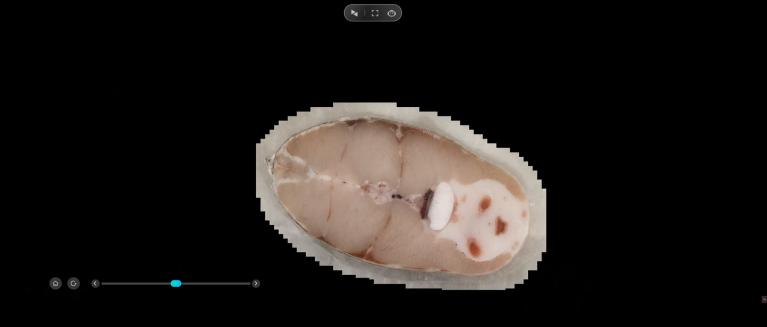
What Is Fish Anatomy and Why Does It Matter?
Fish anatomy is the study of the external and internal structures of fish and the relationships between those structures. Although fish species vary enormously in shape, size, habitat, and physiology, many have anatomical features that perform similar fundamental functions.
For example, most fish have fins for movement and stability, gills for extracting oxygen from water, sensory systems for detecting environmental changes, and digestive organs for processing food. Bony fish commonly also possess a swim bladder, a gas-filled organ that helps regulate buoyancy.
Studying anatomy is important because structure and function are closely connected. A fish’s body is not simply shaped for appearance; its anatomical characteristics reflect the demands of living underwater.
The External Anatomy of a Fish
The easiest way to begin studying fish anatomy is to examine structures that can be observed from the outside.
The fins are among the most recognizable features. The dorsal fin is located on the back, while pectoral and pelvic fins help with movement and control. The anal fin contributes to stability, and the caudal fin, commonly recognized as the tail fin, provides important propulsion. The National Oceanic and Atmospheric Administration (NOAA)’s fish anatomy resources describe these fins according to their positions and roles in movement and control.
The scales and skin also play important roles. In many bony fish, overlapping scales are associated with a layer of mucus. This mucus can reduce drag during swimming and contributes to osmoregulation, helping the fish manage the movement of water and dissolved substances across its body.
Another fascinating structure is the lateral line. Running along the side of many fish, this sensory system detects movement and vibrations in the surrounding water. It gives fish information about their environment that cannot be obtained simply by looking with their eyes.
How Do Fish Breathe?
One of the most important questions in fish anatomy concerns respiration. Unlike humans, fish generally obtain oxygen from water through their gills.
As water passes over the gills, oxygen moves from the water into the bloodstream while carbon dioxide moves in the opposite direction. The folded structure of gill surfaces creates a large area for gas exchange, making this process efficient.
In many bony fish, the gills are protected by an operculum, commonly called the gill cover. Water enters through the mouth and passes across the gills before leaving through the gill-cover region. This coordinated movement allows the fish to continuously obtain dissolved oxygen.
What Organs Are Inside a Fish?
Fish have many internal organs that perform functions familiar from other vertebrates. Anatomical diagrams commonly identify structures such as the heart, liver, stomach, intestine, kidney, gonads, and swim bladder.
The digestive system processes food and absorbs nutrients, while the kidneys contribute to waste removal and regulation of the body’s internal environment. The heart circulates blood through the body and the gills.
For many bony fish, the swim bladder is particularly interesting. It is a gas-filled organ that helps control buoyancy, allowing the fish to maintain its position in the water without constantly swimming to avoid sinking. However, not every fish has a swim bladder, so this feature should not be treated as universal across all fish groups.
Why Fish Anatomy Varies Between Species
There is no single anatomical blueprint that perfectly describes every fish. Fish include highly diverse groups, and their structures can be modified according to habitat, feeding behavior, locomotion, and evolutionary history.
For instance, bony fish generally have ossified skeletons, while sharks and rays have cartilaginous skeletons. Ray-finned fish have fins supported by slender bony rays, whereas lobe-finned fish have fleshy fins with internal bones.
This diversity is one reason why fish anatomy is about more than memorizing labels. Effective anatomy education should help learners understand spatial relationships, structural differences, and the connection between anatomy and biological function.
How We Use Digital Visualization to Support Anatomy Learning
At DIGIHUMAN, we make anatomical structures easier to explore through digital visualization. Our Virtual Anatomy Table organizes anatomy into systematic, regional, and sectional views, featuring more than 6,000 three-dimensional anatomical structures, alongside dissection videos, anatomy animations, and assessment resources.
Although our primary focus is human anatomy and medical education, interactive 3D visualization offers broader educational value by helping learners understand complex structures and their relationships. Ultimately, fish anatomy demonstrates how form supports function, from gills and fins to sensory systems and internal organs. Through our digital anatomy solutions, DIGIHUMAN aims to make anatomy education more visual, interactive, and accessible.

How Are Human and Rat Anatomy Similar?
When we study anatomy, one of the most interesting questions we encounter is how are human and rat anatomy similar?...

What Is the Largest Organ in the Rat’s Anatomy?
When we study animal anatomy, one of the simplest questions can lead to a surprisingly interesting discussion: what is the...

What Does an MRI Scan Show on a Dog?
When pet owners hear that a dog may need an MRI, one of the first questions they often ask is: what...