
Medical schools are being asked to train more people than they can teach. The World Health Organization’s first annual health workforce report, out in June 2026, puts the projected shortfall at 11.1 million health and care workers by 2030. Nearly one in four doctors is already over 55. In high-income countries it is closer to one in three.
Anatomy is where that pressure shows up first. It sits at the start of the curriculum, and it is one of the few subjects still taught on physical specimens. Specimens do not scale.
What Happens at MEDICA 2026 in Germany
MEDICA 2026 runs 16 to 19 November at Messe Düsseldorf. The 2025 edition drew 4,821 exhibitors from 70 countries and 78,000 trade visitors from 160 countries, which is roughly the scale you should plan around.
Several parts of the fair are new this year. A MEDICA MAIN STAGE has been added for keynotes and panel discussions, a feature the event did not previously have. Hall 12 now holds a Healthcare Transformation Campus that gathers the future-facing parts of the programme in one place. HOSPITAL OF THE FUTURE has been rebuilt as well: rather than a row of stands, it presents an integrated hospital environment following a patient through the full care pathway.
Two summits join the programme, one for hospital leadership and one for procurement, alongside the first German Health Resilience Conference and a wearable technologies conference covering digital health and hospital-at-home care.
The hall structure has been reorganised by theme instead of product family, which makes route planning easier than in past years. Health Tech, Healthcare Delivery & Clinical Excellence, and Digital Health, Innovation & Start-ups are the zones most relevant to training and education. Laboratory and diagnostics, imaging, physiotherapy and rehabilitation equipment, medical devices and furniture, and consumables sit in separate areas. International pavilions have their own zone.
| Item | Detail |
| Dates | 16 to 19 November 2026 |
| Venue | Messe Düsseldorf, Düsseldorf, Germany |
| Visitor hours | Monday to Wednesday, 10:00 to 18:00; Thursday, 10:00 to 16:00 |
| Scale | 4,821 exhibitors from 70 countries; 78,000 visitors from 160 countries |
| New in 2026 | MEDICA MAIN STAGE; Healthcare Transformation Campus in Hall 12; redesigned HOSPITAL OF THE FUTURE |
| New summits | Hospital Leadership Summit; Hospital Procurement Summit |
| Hall themes | Health Tech; Healthcare Delivery & Clinical Excellence; Digital Health, Innovation & Start-ups; and five further zones |
| Airport transfer | Light rail U81, roughly seven minutes |
One practical change that makes a short trip easier: the U80 and U81 light rail lines started running on 4 September 2026 and cover the airport to fairgrounds in about seven minutes.
Why Anatomy Teaching Is the Bottleneck the German MEDICA Show Highlights
After a structure is cut it stays cut, so the next group of students inherits a specimen that has already lost detail. This is why anatomy departments track the ratio of students to cadavers. The ratio decides how much hands-on time any single learner gets, and in most schools it is not much.
When the material is scarce, demonstration replaces practice. Students spend more time watching a dissection than performing one. They still memorise the structures, but the relationships between those structures are harder to retain without handling them repeatedly.
The tools that fill the gap cover part of the ground each. Charts show structure without depth. Plastic models hold one fixed shape and cannot be peeled apart. Recorded dissections show a sequence but cannot be paused or rotated. None of them can be repeated on demand.
Digital anatomy addresses that last point rather than replacing the specimen. An Anatomy Teaching System gives students a layer they can rework at no cost. The sequence is short:
- Select a region of the body and bring it up on screen.
- Rotate the view to inspect the structure from another angle.
- Separate or isolate a structure from the tissue around it.
- Remove a layer, examine what sits beneath it, and restore it.
- Repeat until the sequence stops requiring conscious thought.
Regional anatomy, sectional anatomy, and clinical skills rehearsal are the courses where this carries the most weight. All three depend on students building a mental map of structures in three dimensions, and that map comes from repetition.
What DIGIHUMAN Brings to Medical Training in Germany and Beyond
DIGIHUMAN has been working on digital anatomy since 2002, based in Jinan, Shandong, China. Its systems are used in more than 40 countries, expanding its presence in medical schools and training institutions.
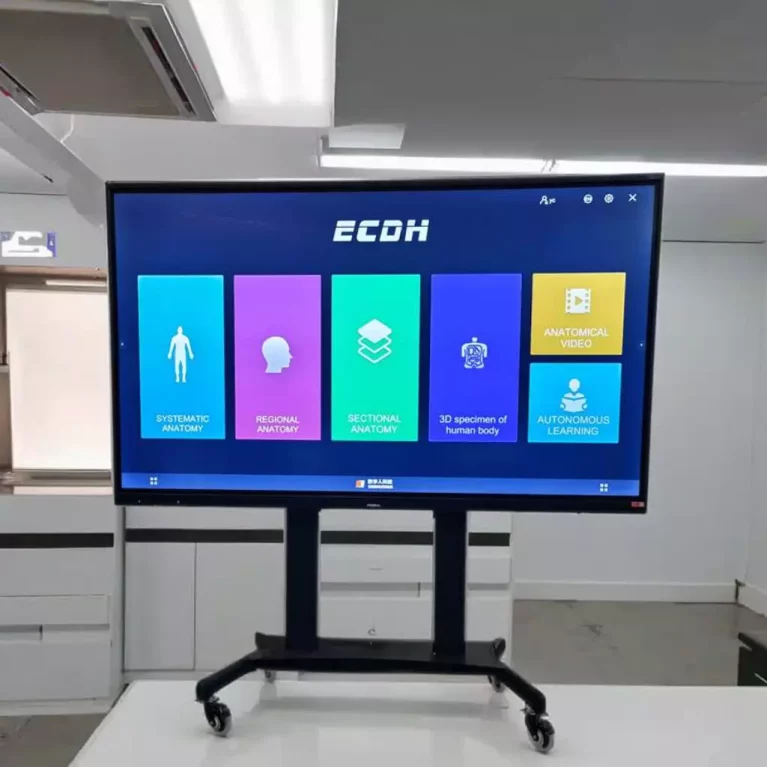
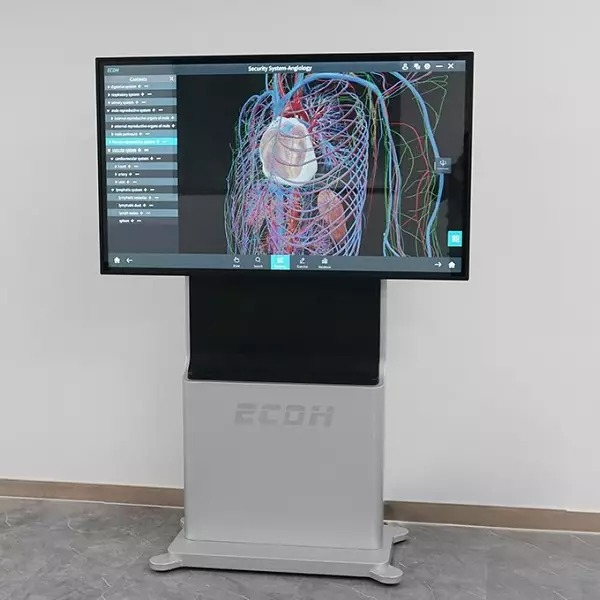
The Anatomy Teaching System comes in three delivery formats. The VR version is a helmet-type 3D stereo setup, designed to place a student inside a virtual anatomical environment. The AR version uses 3D tracking glasses with head tracking and a dedicated interactive pen, and anyone else in the room can follow the same session on an external screen while the operator works over the real environment. The blackboard system is an all-in-one unit, covering system anatomy, regional anatomy, tomographic anatomy, micro-class video, and self-directed learning.
What matters most is the data underneath. The structures are rebuilt from continuous cross-sectional data taken from bodies free of organic disease and defects, at a sectional precision of 0.1mm to 1mm. That yields more than 6,000 reconstructed anatomical structures and 5,000 digital models, and covers both undergraduate and postgraduate teaching stages.
The Virtual Anatomy Table works differently, replacing physical cadavers with interactive 3D models. Students zoom, rotate, and dissect layer by layer. The table ships with more than 1,700 CT and MRI images alongside the tomographic specimen data, plus real dissection videos, anatomy animations, and a set of practice questions. It works with AR and VR setups and runs on tablets, computers, and smartphones.
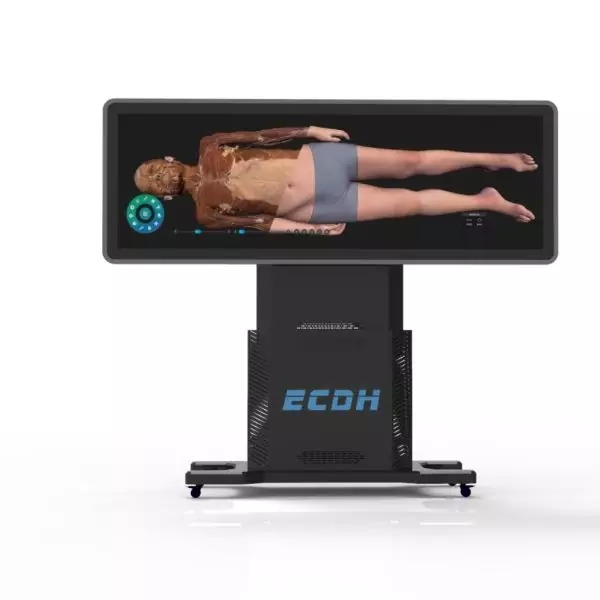
Two practical consequences follow. There is no cadaver to acquire, store, or dispose of, and no formaldehyde exposure. A department equipping a regional anatomy course, a virtual simulation laboratory, or a clinical anatomy training centre can size the room around these systems instead of around a specimen supply.
| System | Best suited to | What the student does |
| VR Anatomy Teaching System | Immersive study of spatial form | Works inside a virtual anatomical environment |
| AR Anatomy Teaching System | Group demonstration and classroom teaching | Operates with glasses and pen while others follow on screen |
| Blackboard System | System, regional, and tomographic anatomy courses | Works through five teaching modules on one unit |
| Virtual Anatomy Table | Repeated dissection practice and self-study | Zooms, rotates, and dissects layers on a touchscreen |
Orders start from one unit. Delivery normally completes within two weeks of full payment, and hardware carries a two-year warranty with an extended option available. Installation guidance and operating instructions are provided, and technical consultants handle questions on setup and use.
Planning Your Visit to MEDICA in Germany and Getting in Touch
Four days is not enough for MEDICA at full size. A route planned in advance makes a difference.
For anyone whose interest is medical training and anatomy teaching, Health Tech and Healthcare Delivery & Clinical Excellence are the zones to prioritise. The Healthcare Transformation Campus in Hall 12 is worth setting aside time for if the focus is on how training fits into a wider care system.
If you want to understand how digital anatomy systems fit into a teaching programme, before the fair or after it, the team can walk through the options with you. Visit the DIGIHUMAN website to see the full range, or use the contact page to reach them directly and ask about pricing, installation, and how these systems are used in current anatomy curricula.

What Is Augmented Reality Medical Training
Medical schools have a quiet math problem. A class of thirty students often shares a single cadaver, and the numbers...

Hierarchical Structure of Anatomy: Understanding the Human Body From Systems to Detailed Structures
The human body is a complex organization built through multiple levels of structure. From large body systems to tiny anatomical...

Virtual Human Project CT Scan: How Digital Human Models Support Modern Anatomy Education
Medical anatomy education is changing with the development of digital technology and medical imaging. For many years, students mainly learned...