
The Medical College Admission Test (MCAT) is arguably the single most critical standardized exam for pre-medical students (premeds) seeking entry into medical school. Designed to assess scientific knowledge and critical thinking, it serves as a core metric for admissions committees evaluating candidate readiness. As students curate their prep materials, a fundamental question frequently emerges: Is Anatomy on the MCAT? While the quick answer is yes, the depth of coverage often surprises test-takers. Purely anatomical questions make up a minor portion of the exam, as the test heavily favors Physiology—emphasizing how organ systems operate dynamically over static anatomical identification.
MCAT Introduction
The Medical College Admission Test (MCAT) is a standardized, multiple-choice examination administered by the Association of American Medical Colleges (AAMC). It plays a pivotal role in the medical school admissions process in the United States and Canada, serving as a primary metric to evaluate a pre-med student’s readiness for the rigors of medical education. The MCAT is divided into four individually scored sections:
Chemical and Physical Foundations of Biological Systems (CPBS) | Focuses on basic physical and chemical principles—including inorganic and organic chemistry, introductory physics, biology, and biochemistry—and how they apply to living systems. |
Critical Analysis and Reasoning Skills (CARS) | Evaluates reading comprehension, critical reasoning, and analysis through passage-based questions drawn from a wide range of humanities and social science disciplines. |
Biological and Biochemical Foundations of Living Systems (BBLS) | Tests foundational concepts in biology, biochemistry, organic chemistry, and inorganic chemistry. This is the primary section where anatomical and physiological concepts appear. |
Psychological, Social, and Biological Foundations of Behavior (PSBB) | Assesses introductory psychology, sociology, and biological foundations of behavior, focusing on how psychological and social factors influence health and behavior. |
Anatomy on the MCAT
When anatomy does appear on the MCAT—primarily within the Biological and Biochemical Foundations of Living Systems section—it is strictly high-level and introductory:
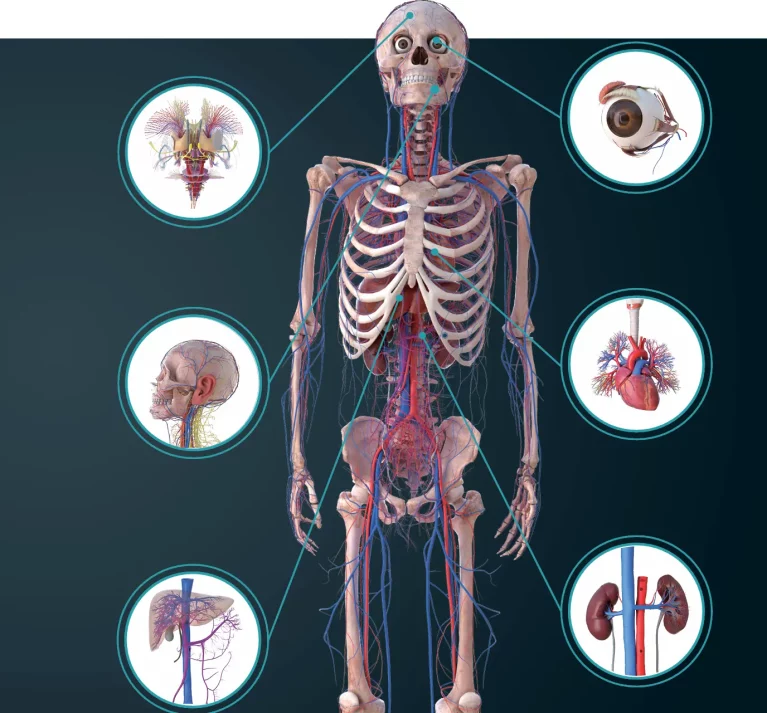
- What IS covered: Basic structural features and high-level organ systems (e.g., the general layout and organ functions of the cardiovascular, renal, nervous, endocrine, digestive, respiratory, and reproductive systems).
- What is NOT covered: Deep, granular anatomical details, such as naming specific bones, memorizing origin/insertion points of skeletal muscles, or tracing fine peripheral nerve pathways.
Why Studying Anatomy Still Helps
Even though direct anatomical questions are sparse, taking an undergraduate Anatomy course offers significant advantages:
On the ne hand, anatomy overlaps heavily with physiology, histology, and biochemistry. Understanding the physical layout of an organ system provides necessary context for understanding its functional mechanism. On the other hand, anatomy is a core, notoriously demanding course during the first year of medical school. Building familiarity with key structures beforehand reduces the learning curve when you step into a medical school gross anatomy lab.
Evolution of Anatomy Education
Historically, anatomy education relied heavily on 2D textbook diagrams, anatomical models, and cadaver dissection in physical labs. While cadaveric study remains a gold standard in medical school, technological advancements have transformed how students learn structural anatomy.
Modern software uses 3D rendering and interactive modeling to allow learners to dissect digital structures layer by layer on standard computers and tablets.
AR and VR devices transporte students into a fully immersive, 360-degree digital laboratory, allowing learners to isolate muscles, trace nerves, and perform risk-free virtual dissections repeatedly without the constraints or expenses of a physical cadaver lab.
To bridge the gap between digital modeling and the tactile scale of a real dissection table, high-tech instruments like the Virtual Anatomy Table (such as the DIGIHUMAN virtual dissection table) were developed:
- Life-Sized Visualization: These tables display full-scale, 3D interactive human anatomy modeled from real human cadaver scan data.
- Interactive Dissection: Users can cut, slice, isolate, and reconstruct anatomical systems in real time using touch interface controls.
- Multi-Angle Pathology & Cross-Sections: Students can view cross-sectional anatomy alongside standard 3D views, making it easier to correlate spatial anatomy with radiological imaging like CT scans and MRIs.

Empowering Future Medical Professionals with DIGIHUMAN
At DIGIHUMAN, we recognize the importance of mastering anatomy for success on the MCAT and in medical education. Our HD Digihuman Virtual Anatomy Table is designed to empower students with the tools they need to excel. By providing an interactive and immersive learning experience, we help students build a solid foundation in anatomy, ensuring they are well-prepared for the challenges ahead. Together, we are dedicated to shaping the next generation of healthcare professionals who are equipped to thrive in their medical careers.

MEDICA 2026 in Germany: What Medical Training Technology Looks Like This Year
Medical schools are being asked to train more people than they can teach. The World Health Organization's first annual health...

What Is Augmented Reality Medical Training
Medical schools have a quiet math problem. A class of thirty students often shares a single cadaver, and the numbers...

Hierarchical Structure of Anatomy: Understanding the Human Body From Systems to Detailed Structures
The human body is a complex organization built through multiple levels of structure. From large body systems to tiny anatomical...