
If you have ever looked at a dog and wondered what a dog’s anatomy looks like, the answer is more fascinating than simply describing bones and organs. A dog’s body is a highly coordinated system in which the skeleton, muscles, organs, nerves, blood vessels, and sensory structures work together. By studying these structures, we can better understand how dogs move, breathe, digest food, respond to their surroundings, and maintain normal body functions.
At DIGIHUMAN, we believe that digital visualization can make complex anatomical knowledge easier to explore. Before discussing how digital anatomy can support learning, let us first look at the major features that answer the question: what does a dog’s anatomy look like?
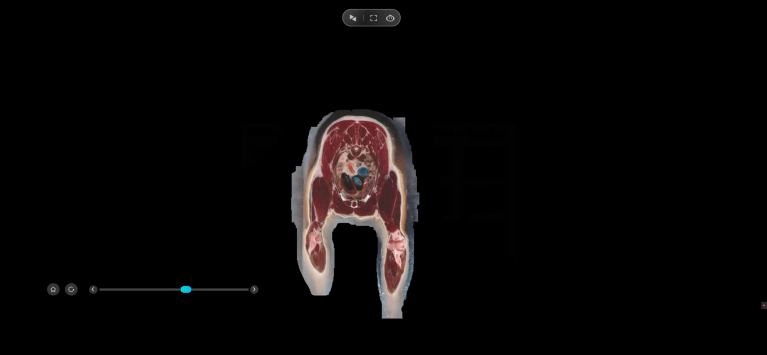
How Is a Dog’s Skeleton Structured?
The canine skeleton provides the framework that supports the body and protects important internal organs. Like other mammals, dogs have a skull, vertebral column, ribs, limbs, and numerous smaller bones. The vertebral column extends from the neck through the back and supports the spinal cord while helping the body maintain stability during movement.
A dog’s limbs are also adapted for efficient locomotion. The forelimbs and hindlimbs contain interconnected bones and joints that work with muscles and tendons to produce movement. The exact shape and proportions can vary considerably between breeds, but the fundamental anatomical organization remains similar.
The skeleton is not simply a rigid framework. Joints, cartilage, ligaments, and muscles work together to provide controlled movement. This relationship is particularly important when studying how dogs walk, run, jump, or change direction.
What Are the Major Internal Systems in a Dog?
Understanding canine anatomy also requires looking beyond the skeleton. Veterinary anatomy commonly examines major systems including the digestive, respiratory, cardiovascular, nervous, urogenital, endocrine, and locomotor systems.
The digestive system processes food and absorbs nutrients. Major structures include the mouth, esophagus, stomach, intestines, liver, and associated organs. Their coordinated activity allows nutrients to be broken down, absorbed, and distributed for use by the body.
The respiratory system enables oxygen intake and carbon dioxide removal. Air travels through structures such as the nasal passages, pharynx, larynx, trachea, and bronchi before reaching the lungs.
The cardiovascular system circulates blood throughout the body. The heart pumps blood through an extensive network of arteries, veins, and smaller blood vessels, delivering oxygen and nutrients while carrying metabolic waste away from tissues.
The nervous system provides another layer of complexity. The brain, spinal cord, and peripheral nerves coordinate movement, sensation, and many physiological processes. This is one reason anatomical relationships are often easier to understand when they can be viewed spatially rather than only through two-dimensional illustrations.
Why Is Canine Anatomy Difficult to Learn From Flat Images?
One challenge in anatomy education is understanding the three-dimensional relationship between structures. A textbook diagram may show a particular organ clearly, but learners may still struggle to visualize what lies behind, beneath, or around it.
For example, understanding the location of nerves relative to muscles and blood vessels requires more than memorizing individual names. Students need to understand depth, orientation, connections, and spatial relationships.
This is where interactive digital anatomy can provide an additional learning approach. Instead of treating an anatomical structure as a static picture, a digital model can allow learners to examine structures from different perspectives. Rotating, enlarging, or separating structures can make relationships easier to interpret.
How Can Digital Anatomy Support Anatomical Learning?
At DIGIHUMAN, we develop digital medical education technologies designed to make anatomy more visual and interactive. Our virtual anatomy solutions organize anatomical information into systematic, regional, and sectional approaches. The company’s virtual anatomy table information states that its platform contains more than 6,000 3D anatomical structures and includes dissection videos, anatomy animations, and question resources.
Our virtual anatomy table is primarily designed around human anatomy education, so it should not be presented as a replacement for specialized veterinary anatomy resources. However, the underlying principle of interactive three-dimensional visualization is highly relevant to anatomical education in general.
For educators and learners, digital visualization can help demonstrate how structures relate to one another. A teacher can use three-dimensional models to explain spatial concepts, while students can repeatedly review structures without relying exclusively on physical specimens.
What Does a Dog’s Anatomy Look Like in Three Dimensions?
The skeleton establishes the body’s framework. Muscles create movement. The cardiovascular and respiratory systems support tissue function. The digestive system processes nutrients, while the nervous system coordinates information and responses. These systems occupy specific regions of the body and interact continuously.
That interconnected nature is what makes anatomy both challenging and rewarding to study. Whether the learner is examining a dog, another animal, or the human body, understanding anatomy means understanding relationships between structures.
At DIGIHUMAN, we focus on using digital technology to make anatomical education more visual, interactive, and accessible. Our virtual anatomy table solutions are developed for medical education and training, providing tools for exploring complex three-dimensional anatomical information.

How Are Human and Rat Anatomy Similar?
When we study anatomy, one of the most interesting questions we encounter is how are human and rat anatomy similar?...

What Is the Largest Organ in the Rat’s Anatomy?
When we study animal anatomy, one of the simplest questions can lead to a surprisingly interesting discussion: what is the...

What Is Fish Anatomy? A Simple Guide to How Fish Are Built and How They Survive
When we look at a fish swimming through water, its streamlined body may seem simple. However, beneath the scales and...