
For generations, the foundational study of human anatomy has relied on traditional methods—cadaver dissection, textbooks, and two-dimensional illustrations. While these methods have historical value, we at DIGIHUMAN recognize that they present significant limitations for modern medical institutions worldwide. As a company dedicated to wholesale and export, our mission is not just to sell equipment, but to revolutionize global medical teaching by providing cutting-edge, ethical, and highly precise solutions.
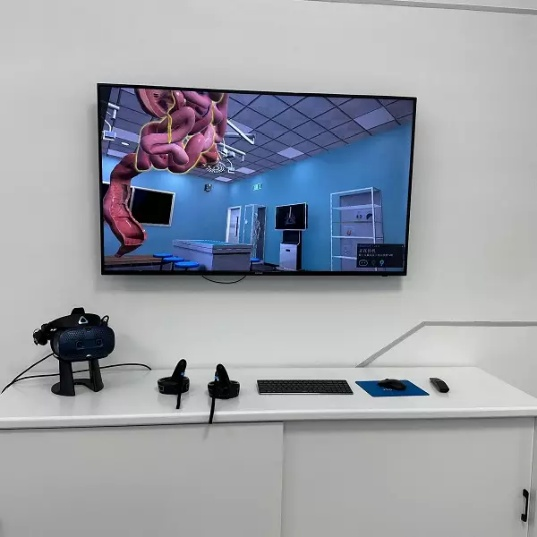
We believe the key to this revolution lies in immersive technology, specifically Virtual Reality Anatomy Education.
The Imperative for Change in Anatomy Learning
The challenges facing institutions attempting to provide high-quality anatomical training are constant and complex. We observe three major hurdles that traditional methods struggle to overcome:
- Ethical and Supply Concerns: The procurement, preservation, and disposal of human cadavers involve intricate ethical debates and face growing logistical and resource shortages globally. Many institutions struggle to maintain adequate, consistent access to specimens.
- Limitations of Spatial Visualization: Textbooks and 2D charts, while informative, inherently fail to convey the complex, three-dimensional relationships of structures within the human body. Students often struggle to translate flat diagrams into the operational spatial awareness required for surgery or diagnostics.
- Scale and Accessibility: Traditional labs limit the number of students who can effectively interact with a specimen simultaneously. Furthermore, once a dissection is performed, it cannot be reset, limiting the repetition essential for mastery.
These limitations diminish learning efficiency and restrict the hands-on experience that is vital for nurturing confident future medical professionals.
Virtual Reality Anatomy Education: A Revolutionary Shift
Through years of professional research and collaboration with leading medical experts, we developed the solution: a complete ecosystem built on digital human models. Our approach ensures that every detail is captured with unparalleled accuracy, eliminating the constraints of traditional teaching while offering superior, scalable, and risk-free practice.
Virtual Reality Anatomy Education transforms the learning environment into a dynamic, interactive space where students take ownership of their exploration. They can observe, manipulate, and dissect structures repeatedly without any ethical or supply worries. This immersive nature has been proven to be far more engaging, enjoyable, and motivating than conventional tools, leading directly to a deeper, more intuitive understanding of spatial relationships.
Why DIGIHUMAN’s Approach to Virtual Reality Anatomy Education Stands Apart
At DIGIHUMAN, we don’t just provide a viewing tool; we provide the only comprehensive VR anatomy teaching product based on ultra-high-resolution 3D reconstruction technology. Our digital models are sourced and meticulously vetted by the Chinese Society for Anatomical Sciences’ Committee of Experts, guaranteeing anatomical accuracy down to 30 microns.
This commitment to precision allows us to support institutional teaching goals through a robust and multifaceted system. Our software architecture is built around eight main systems, ensuring a comprehensive, guided, and interactive experience:
- Wizard System: Provides text and voice guidance for first-time users.
- Multimedia System: Includes video player functionality for supplementary lectures and content.
- Graphics and Image System: Integrates slice tomographic images, CT, and other medical imaging data.
- Voice System: Features voice-based controls and feedback.
- Puzzle System: Challenges students with three-dimensional model splicing across three difficulty levels.
- Practices System: Offers structured exercises, including single-choice and multiple-choice questions for binding practice.
- UI System: Ensures a professional, intuitive, and cohesive software interface design.
- Interactive System: Allows students to access and manipulate a rich variety of accurately represented anatomical models (organs, bones, muscles, systems).
Precision and Performance: Introducing the DIGIHUMAN VR Anatomy Teaching System
The DIGIHUMAN VR Anatomy Teaching System (Model ECDH-Int VR) is designed for multi-person collaborative classes, perfectly addressing the needs of wholesale procurement for large educational facilities. Our systems are ready for immediate deployment in advanced medical institutions globally.
The immersive experience is powered by carefully selected, high-performance hardware, ensuring optimal fidelity and responsiveness for real-time manipulation:
DIGIHUMAN VR Anatomy Teaching System Hardware Configuration
- VR Headset (Vive Glasses):
- Resolution: Monocular resolution is 1080 x 1200 pixels, yielding a combined resolution of 2160 x 1200 pixels.
- Refresh Rate: 90 Hz, minimizing motion sickness and ensuring smooth visualization.
- Field of View (FOV): 110 degrees, providing a wide and natural viewing space.
- Safety & Sensors: Features the VIVE escort guidance system, a front camera, Steam VR tracking technology, G-sensor correction, a gyroscope, and a proximity sensor.
- Ergonomics: Includes binocular diastolic design with interpupillary distance and lens distance adjustment.
- Hand Controllers:
- Functionality: Accurately track hand movements, enabling students to grab, rotate, dissect, and manipulate virtual anatomical structures in real-time. This provides a crucial, hands-on learning experience.
- Vive Computer Configuration (Minimum Required Specs for Optimal Performance):
- CPU: Intel 17
- Memory: 16GB DDR4 RAM.
- Storage: 240GB Solid-State Drive (SSD).
- Video Memory Capacity: 6GB dedicated VRAM.
These specifications ensure the ultra-fast loading speed and highly precise rendering that DIGIHUMAN is known for. Our reliance on professional-grade hardware and specialized software, including our self-developed Tai engine, ensures that a loading speed of no more than 30 seconds is consistently achieved—a vital factor in managing large-scale classroom time.
Embracing the Future of Education
Since our establishment in 2002, we have been deeply engaged in the field of medical education, and our VR anatomy and physiology equipment have been affirmed by customers in over 40 countries. Our specialized focus on wholesale and export allows us to serve institutions across the world, offering excellent products and comprehensive after-sale services.
For any institution looking to transition away from the constraints of traditional teaching and provide students with a deeply engaging, geometrically accurate, and scalable approach to anatomy, the DIGIHUMAN VR Anatomy Teaching System is the clear choice. We welcome partners, distributors, and medical schools to contact us for business cooperation and see how we can collaboratively shape the future of medical training.

Revolutionizing Medical Education: Understanding the True Value and Human Anatomy VR Price
As pioneers in advanced medical virtualization, we at DIGIHUMAN have witnessed a fundamental shift in how anatomical knowledge is imparted...

Revolutionizing Medical Education: Why Human Anatomy VR for Institutions is Essential
As medical education evolves, the need for innovative and highly accurate teaching tools has never been greater. For years, educators...
Transforming Medical Education: The Power of Anatomy Physiology VR
In the specialized field of medical education, the foundational study of human anatomy and physiology has always been paramount. However,...