
As specialists in advanced medical education technology, we at DIGIHUMAN frequently engage with educators, researchers, and institutional procurement teams focused on the precise study of the human body. One of the most common points of semantic—and practical—confusion we encounter revolves around two foundational terms in anatomy and pathology: dissection and autopsy. While both procedures involve surgically opening a body for internal examination, their purposes, methods, and legal contexts are fundamentally distinct.
For medical institutions, wholesale distributors, and academic buyers, understanding the precise role of each procedure is vital, not only for curriculum design but also for selecting the most appropriate modern educational tools. This article aims to clearly define and differentiate these two critical anatomical practices and, in doing so, showcase how DIGIHUMAN is revolutionizing the learning experience.
What is Dissection? The Foundation of Anatomical Study
In the context of medicine and biology, dissection (also known as anatomization) is primarily an educational or research procedure. The core goal of dissection is systematic, detailed, and layer-by-layer exploration of the human or animal body to understand its normal structure, relationships between organs, and overall physiological architecture.
When students engage in dissection—traditionally on preserved cadavers—their focus is not on diagnosing a cause of death but on painstakingly mapping the anatomical landscape. The procedure is iterative and often takes weeks or months as students carefully remove tissue, identify small nerves and vessels, and appreciate the spatial relationship of complex structures like the brachial plexus or the aortic arch. The primary subject material used for this purpose is typically donated human bodies that have been specially embalmed (“fixed”) to halt decay and maintain tissue integrity for prolonged study.
The procedure of dissection, while invaluable for establishing foundational anatomical knowledge, is inherently limited by the scarcity of specimens, high maintenance costs, and the ethical sensitivities surrounding human remains.
What is Autopsy? The Quest for Cause and Manner
In sharp contrast to the educational purpose of dissection, an autopsy (derived from Greek for “seeing for oneself”, also called a post-mortem examination or necropsy) is a surgical procedure performed on a corpse to determine the cause, mode, and manner of death, or to evaluate the extent of disease or injury.
Autopsies are typically classified into two main types:
- Medico-legal (Forensic) Autopsy: Ordered by law enforcement or a coroner in cases of sudden, suspicious, violent, or unexplained death. The focus is strictly investigative, aiming to gather evidence to aid in legal proceedings.
- Clinical (Pathological) Autopsy: Performed in a hospital setting with family consent to clarify a medical diagnosis, evaluate the effectiveness of treatment, or contribute to medical research.
In an autopsy, the pathologist’s examination is typically faster and far less focused on detailed, layer-by-layer anatomical exposure. The procedure involves systematically opening the major body cavities—cranial, thoracic, and abdominal—and removing organs for gross and microscopic examination. The objective is diagnostic, requiring swift and efficient retrieval of pathological evidence rather than prolonged study of normal anatomy.
Clearly Defining What is the Difference Between Dissection and Autopsy
For our B2B partners who rely on accuracy for curriculum delivery, a clear demarcation is essential. While the act of cutting the body occurs in both, the underlying objectives dictate entirely different protocols. Below, we clearly outline what is the difference between dissection and autopsy:
- Primary Goal:
- Dissection: Education and research (studying normal anatomy).
- Autopsy: Diagnosis and investigation (determining abnormal pathology, injury, or cause of death).
- Subject Condition:
- Dissection: Usually chemically preserved (embalmed) cadavers, intended for extended study.
- Autopsy: Bodies may be “fresh”,refrigerated, or sometimes decomposed, with the examination needing to be performed promptly.
- Methodology & Scope:
- Dissection: A painstaking, systematic, layer-by-layer uncovering of the entire body, often focusing on small, intricate structures over a long period.
- Autopsy: A standardized procedure focused on opening the major cavities (skull, chest, abdomen) to remove and examine the viscera; less focus on peripheral anatomical details unless related to the cause of death.
- Context:
- Dissection: Performed by students and instructors in an anatomy lab setting.
- Autopsy: Performed by a forensic or surgical pathologist in a mortuary or hospital lab, often under legal jurisdiction.
DIGIHUMAN: Bridging the Gap in Modern Anatomical Training
The necessity for students to master anatomy remains absolute, yet the traditional methods of dissection face growing ethical, logistical, and financial constraints. Furthermore, students require exposure to a vast range of pathological cases that traditional labs often cannot provide.
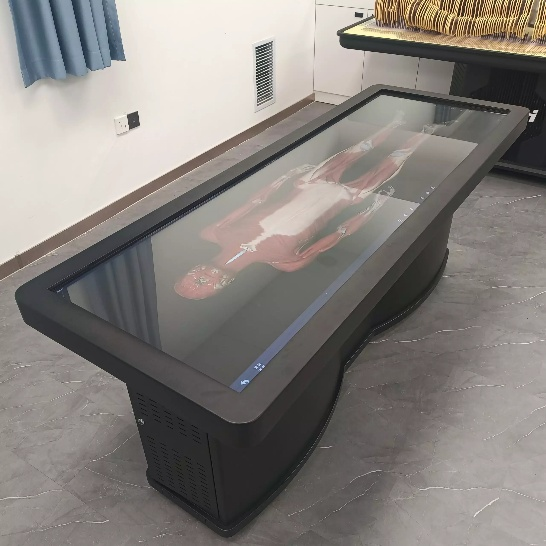
This is where the future of medical education, and the core of our wholesale offering, comes into play. We understand that medical professionals need training that is ethical, repeatable, and infinitely adaptable. To address these needs for our institutional partners, DIGIHUMAN developed the Virtual Anatomy Table.
Our DIGIHUMAN Virtual Anatomy Table is an advanced platform integrating cutting-edge hardware and software to create interactive, high-resolution anatomical models. The system features:
- Ultra-High Definition Data: We utilize world-leading Ultra High Definition (UHD) tomographic data, ensuring that students can visualize fine structures that may be difficult or impossible to observe in traditional specimens.
- Comprehensive Pathology: The system is equipped with corresponding clinical data, including over 1,700 CT and MRI images, enabling students to explore both normal anatomy and a vast library of pathological conditions.
- Interactive Simulation: The large-format, touch-control operation allows students to virtually “dissect”,zoom, rotate, and cut the human body in any direction or angle at different layers, offering an immersive, risk-free, and repeatable learning experience that transcends the limitations of a single, fixed cadaver.
By providing detailed, accurate, and ethical alternatives, DIGIHUMAN empowers medical institutions to deliver superior training in anatomy and pathology. Whether the curriculum calls for the meticulous study of normal human structures (dissection) or the rapid diagnosis of pathological changes (autopsy preparation), our digital solutions ensure that students are prepared for the realities of the modern medical field. We welcome inquiries from wholesale and export partners ready to embrace the future of medical virtualization.

Revolutionizing Medical Education: Understanding the True Value and Human Anatomy VR Price
As pioneers in advanced medical virtualization, we at DIGIHUMAN have witnessed a fundamental shift in how anatomical knowledge is imparted...

Revolutionizing Medical Education: Why Human Anatomy VR for Institutions is Essential
As medical education evolves, the need for innovative and highly accurate teaching tools has never been greater. For years, educators...
Transforming Medical Education: The Power of Anatomy Physiology VR
In the specialized field of medical education, the foundational study of human anatomy and physiology has always been paramount. However,...